How Chiropractic Adjustments Help Your Brain and Body Work Better
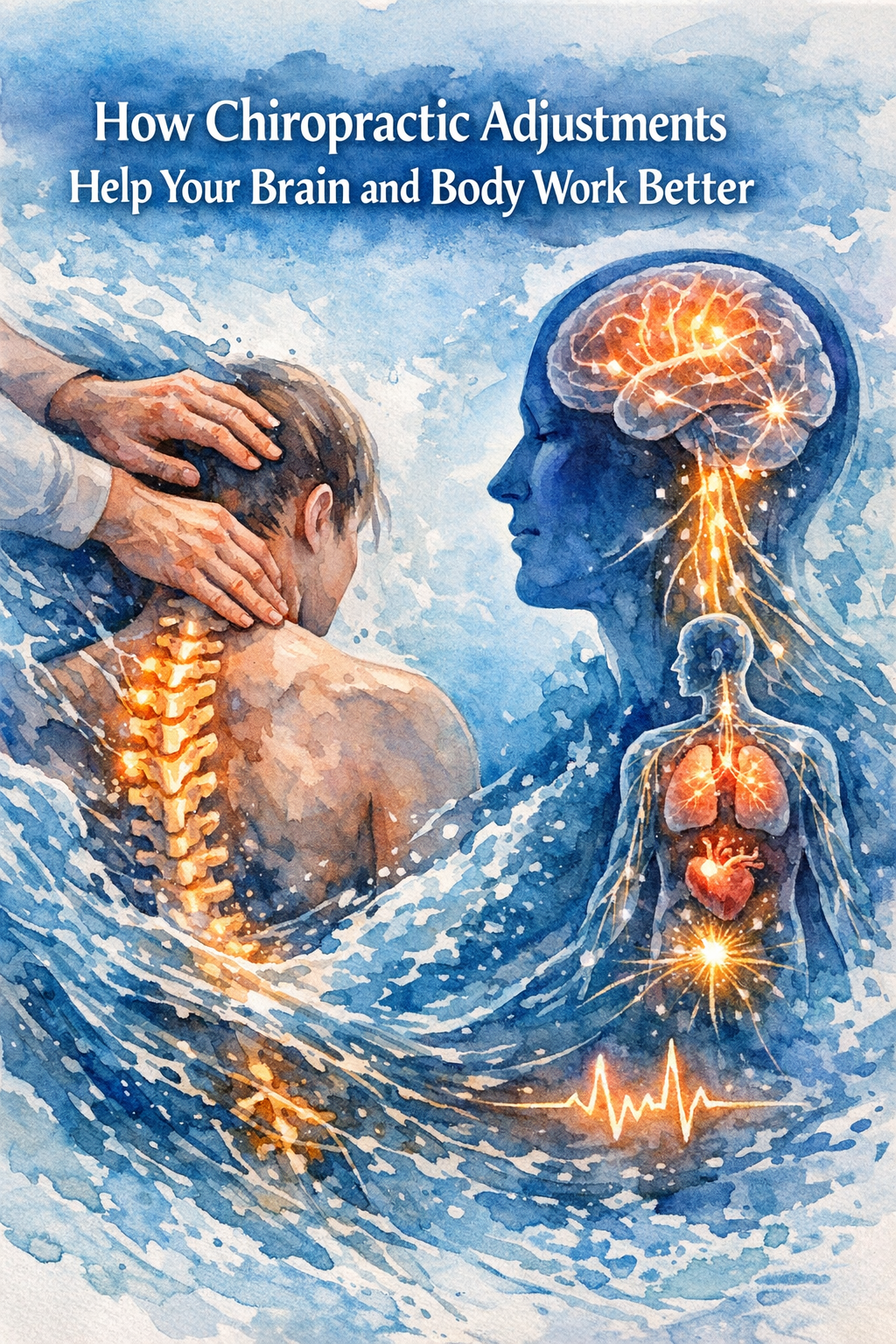
Chiropractic adjustment?
What Does the Science Say?
How Chiropractic Adjustments Help Your Body & Brain
Beneath that quick "pop" in your spine, something much deeper is happening. Discover how care rewires your brain-body connection.
Book Your AssessmentIf you’ve ever had a chiropractic adjustment, it might have felt like a quick “pop” in your neck or back. But beneath that simple sensation, something much deeper is happening. Recent research shows that chiropractic care can influence not just your muscles and joints, but even the way your brain and nervous system communicate with your body [1–3].
Let’s break down what three key studies tell us—in plain language—and what this means if you are sitting with back pain, neck stiffness, or headaches.
What 3 Key Research Papers Show Us
Using advanced brain imaging, researchers found that adjustments change how the prefrontal cortex processes spinal signals, helping "reset" your brain's internal movement map [1].
Restricted spinal joints disrupt nerve signals and cause muscles to fire out of sync. High-velocity thrusts restore joint motion and "retune" muscle control [2].
Pain and stiffness distort your sense of position (proprioception). Spinal manipulation restores clear sensorimotor communication to improve balance and coordination [3].
What These Findings Mean for You
Taken together, this research demonstrates that targeted spinal adjustments provide far more than short-term relief [1–3]:
Reduced Pain & Stiffness
Freeing up restricted joints eases local discomfort and relieves mechanical tension in surrounding tissues [2,3].
Smoother Movement
Clearer signals between your spine and nervous system allow your body to move more fluidly and efficiently [1–3].
Improved Posture & Control
Better input signals mean posture, balance, and daily activities (like sitting or lifting) feel natural [2,3].
Long-Term Recovery Support
Restoring normal sensorimotor integration helps protect your spine and reduces the risk of repeated flare-ups [3].
Is This Relevant to Your Symptoms?
If you are experiencing any of the following, your spine and nervous system can benefit from targeted care [1–3]:
- Chronic back or neck pain that doesn't seem to clear up on its own
- Headaches linked to posture, neck tightness, or stress
- Stiffness or decreased mobility following an injury or long periods sitting
- Feeling clumsy, awkward, or off-balance during everyday movement
What Your Assessment Includes
During your initial visit, your chiropractor will evaluate your spine and movement patterns, apply precise techniques tailored to your needs, and pair adjustments with simple stretches or exercises to lock in lasting improvements.
References
Haavik H, Niazi IK, Holt K, Jaberzadeh S. Manipulation of dysfunctional spinal joints affects sensorimotor integration in the prefrontal cortex: a brain source localization study. J Manipulative Physiol Ther. 2017;40(6):411–420.
Pickar JG, Bolton PS. The contemporary model of vertebral column joint dysfunction and impact of high‑velocity, low‑amplitude controlled vertebral thrusts on neuromuscular function. J Electromyogr Kinesiol. 2012;22(5):677–688.
Lelic D, Niazi IK, Holt K, Jochumsen M, Dremstrup K, Yielder P, et al. The role of spinal manipulation in addressing disordered sensorimotor integration and altered motor control. J Electromyogr Kinesiol. 2016;29:76–81.