How Your Neck, Posture, and Sleep Apnoea Are Connected
Struggling to sleep?
What if your neck keeps you awake at night?
Sleep Apnoea & Your Neck
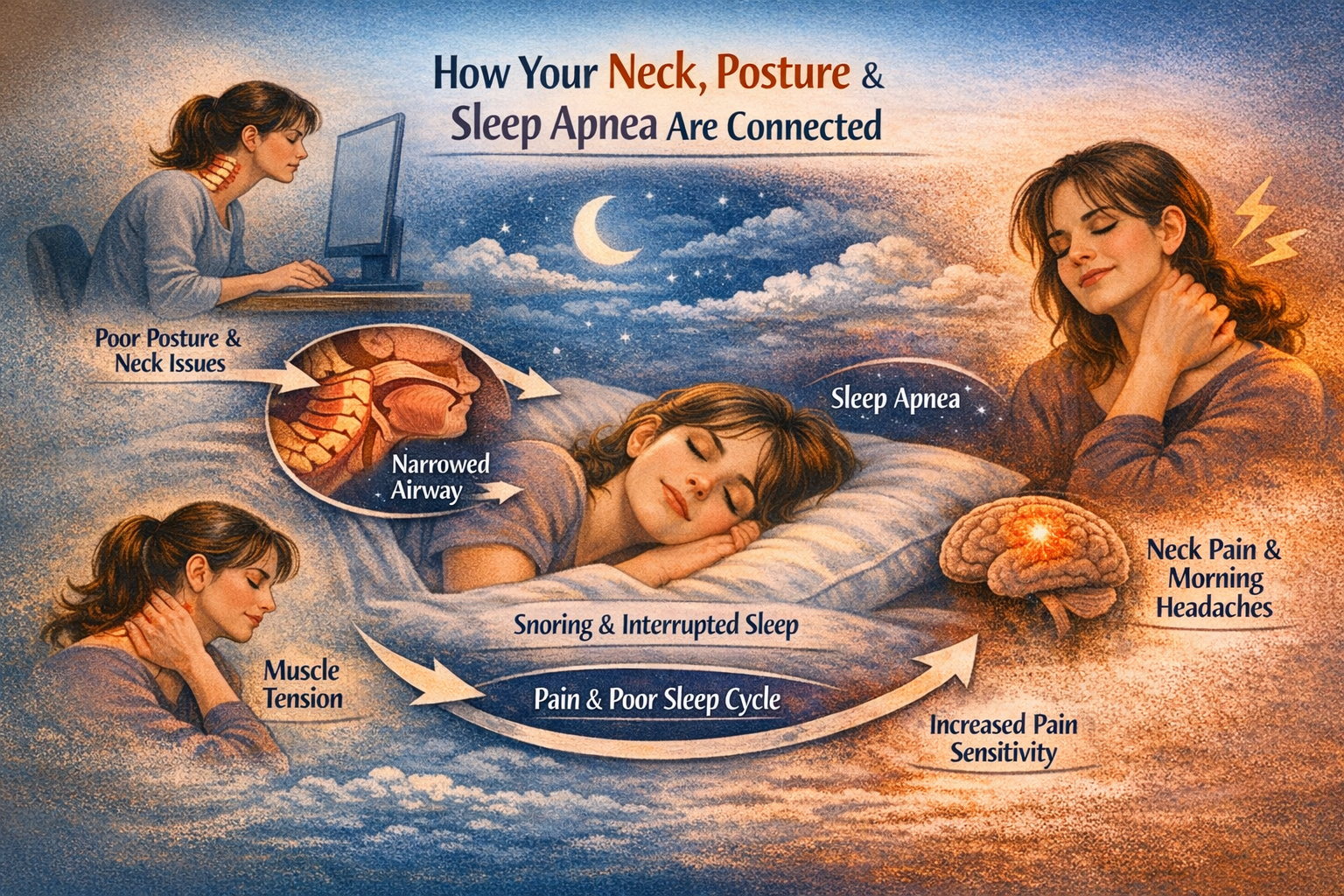
Most people think obstructive sleep apnoea is just about snoring. Research shows your neck setup and posture quietly influence how you breathe at night.
Book Your AssessmentMost people think obstructive sleep apnoea (OSA) is just about snoring or a blocked airway. But research shows that the way your neck and posture are set up can quietly influence how well you breathe at night [1].
If you wake up tired, your neck feels stiff in the morning, or your posture seems to affect everything from your shoulders up, you’re not imagining it—there’s real science behind that connection [1].
What Sleep Apnoea Really Is
Obstructive sleep apnoea happens when the airway becomes too narrow or collapses during sleep. Common symptoms include loud snoring, gasping, waking suddenly, restless nights, morning headaches, and a heavy, foggy feeling the next day [1].
What the Research Tells Us
A recent systematic review explored the link between the cervical spine, posture, neck pain, and sleep apnoea [1]. Key findings include:
Postural Changes
People with OSA frequently show forward head posture, a flattened natural neck curve, and joint stiffness in the upper cervical spine [1].
Forward Head Drift
Hours on screens or at a desk tighten submandibular muscles, reducing space behind the tongue and changing airway angles [1].
The Neck Pain Cycle
Poor sleep increases pain sensitivity, while neck pain disrupts sleep quality—creating a cycle that requires addressing both sides [1].
Cervical Motion & Breathing
The cervical spine regulates airway size and throat muscle tone. When neck motion is restricted, airway function can suffer [1].
What This Means for You
If you suffer from snoring, pauses in nighttime breathing, poor sleep quality, morning headaches, or persistent forward head posture, your neck and airway are likely influencing each other [1].
- Better Airway Space: Improving neck mobility helps maintain clearer airway passages.
- Reduced Morning Stiffness: Addressing upper cervical mechanics eases morning neck pain and tight shoulders.
- Improved Nighttime Rest: Breaking the pain-sleep cycle supports deeper, more restorative sleep.
Where Chiropractic and Exercises Fit In
Chiropractic care doesn’t “cure” sleep apnoea, but research indicates that improving neck mobility, reducing muscle tension, and correcting posture removes factors that worsen airway collapse [1].
Targeted Exercise Evidence
A second study evaluated modified cervical and shoulder retraction exercises in patients with a flattened neck curve and neck pain [2]. After several weeks, participants showed a restoration of their healthy cervical curve, reduced pain, and improved neck range of motion [2].
Putting It All Together
Chiropractic care and specific rehabilitation exercises do not replace CPAP or primary medical treatments for sleep apnoea. Instead, they act as a vital supportive layer—helping you breathe, move, and rest more easily [1,2].
References
Sutherland K, Cistulli PA. Obstructive sleep apnea’s association with cervical spine abnormalities, posture, and pain: A systematic review. Sleep Med. 2020;75:231‑240. doi:10.1016/j.sleep.2020.08.041
Lee MY, Jeon H, Choi JS, Park Y, Ryu JS. Efficacy of modified cervical and shoulder retraction exercise in patients with loss of cervical lordosis and neck pain. Ann Rehabil Med. 2020;44(3):210‑217. doi:10.5535/arm.19117