No, Chiropractic Adjustments Do Not Cause Strokes
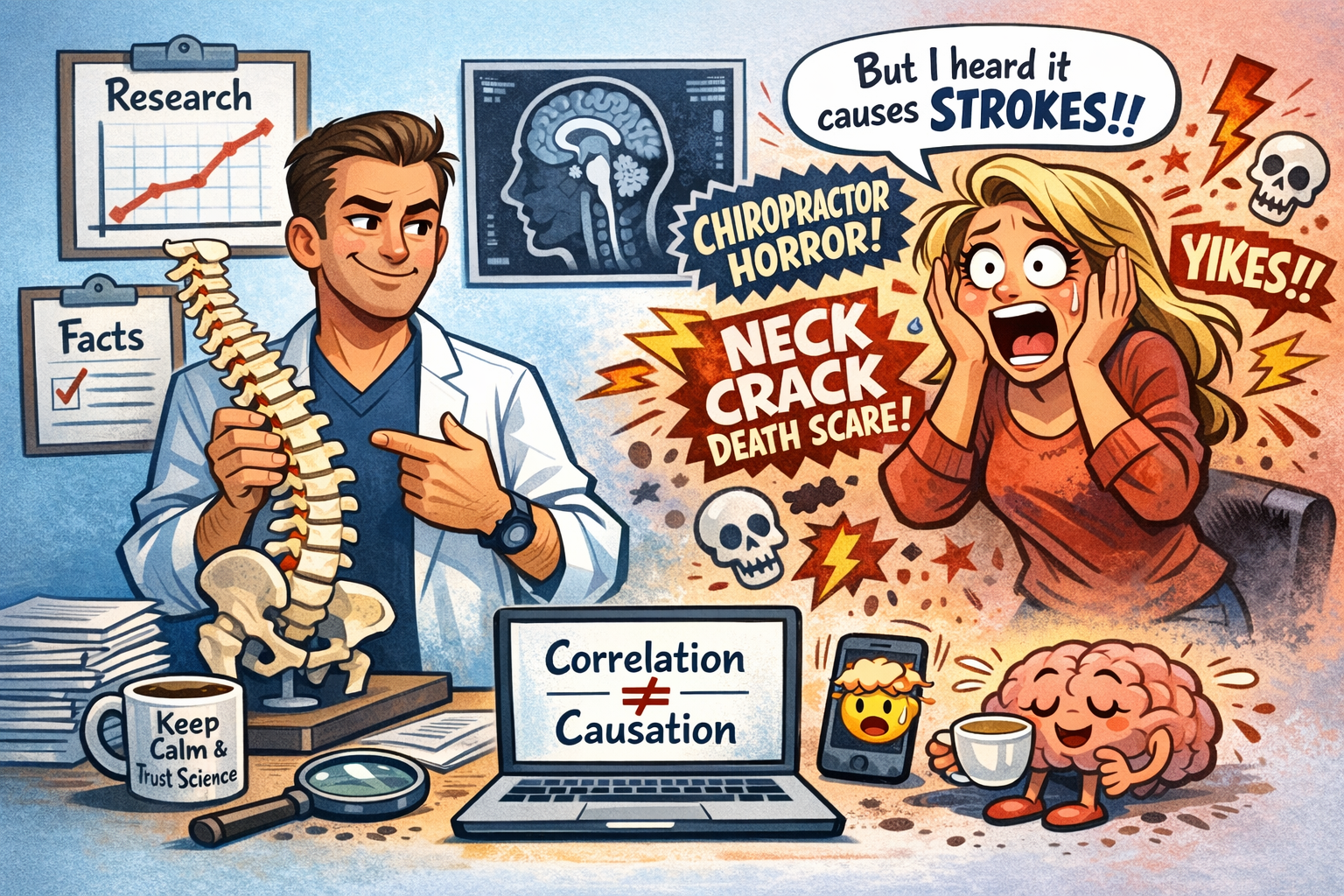
Your neck adjustment isn’t the problem
Your google search history is…
Are Chiropractic Adjustments Safe?
Examining stroke risk, arterial health, and the facts behind spinal manipulation through six major scientific studies, and yes it is relatively safe.
Book Your ConsultationWhen people hear about chiropractic care—especially spinal adjustments—one of the first concerns they voice is safety: specifically, whether adjustments can cause strokes or other serious complications.
This fear, often fueled by sensational headlines and misinterpreted research, deserves an evidence-based review. Let’s break down what the scientific consensus shows through six major studies examining this issue from different angles.
1. What the Research Really Says About Risk
A large retrospective analysis found that serious adverse events among people receiving spinal manipulative therapy are exceedingly rare—far less frequent than complications from many common medical interventions [1].
The rate of severe outcomes is estimated at less than one per several million treatments, confirming that chiropractic adjustments are statistically very safe when performed by trained professionals.
2. Looking at Cervical Artery Dissection
Several studies have explored whether chiropractic care could trigger a cervical artery dissection—a tear in a neck artery that can lead to stroke. These include large-scale investigations of U.S. adults [2], studies assessing vertebral artery dissection in patient cohorts [3], and case-crossover analyses of carotid stroke risk [4].
The outcome: Each study found little to no evidence suggesting a causal relationship. Instead, researchers noted that individuals who suffered dissections often sought care for neck pain that was already an early symptom of a vascular injury. In other words, the stroke risk was linked to the underlying pre-existing condition, not the adjustment itself.
3. Putting It into Systematic Context
Two comprehensive systematic reviews help clarify the broader scientific consensus:
Systematic Review #1
Assessed cervical spine manipulation and carotid artery dissection, finding no proven causal link between chiropractic treatment and arterial dissections [5].
Meta-Analysis #2
Evaluated chiropractic care and cervical artery dissection, reinforcing that current medical evidence does not support causation [6].
4. Correlation vs. Causation
Misunderstandings often arise due to timing. If someone develops stroke symptoms after visiting a chiropractor, it is easy to assume a connection. However, in documented cases, the arterial dissection was already underway before the appointment—producing neck pain, dizziness, or headaches that prompted the visit in the first place [2-4]. The adjustment didn’t cause the injury; the timing was simply coincidental.
5. What This Means for Patients
For patients, these findings mean you can confidently include chiropractic care in your wellness plan without undue fear. Skilled chiropractors use precise, evidence-based techniques, and ongoing research confirms that serious complications are exceedingly uncommon.
Key Take-Home Messages
- Exceedingly Rare Risk: Serious complications are far less frequent than with many routine medical procedures [1].
- No Proven Causal Link: Research consistently fails to show that spinal manipulation causes stroke or arterial dissection [2-6].
- Pre-Existing Conditions: Symptoms like neck pain that prompt care are often the initial signs of a pre-existing vascular event [2-4].
- Timing ≠ Causation: Coincidental timing does not equal a causal relationship [3,4].
- Safe & Effective: Chiropractic care delivered by qualified professionals remains a safe, effective option for musculoskeletal health [1,5].
References
A retrospective analysis of the incidence of severe adverse events among recipients of chiropractic spinal manipulative therapy. Eric Chun‐Pu Chu, Robert J. Trager, Linda Yin‐King Lee & Imran Khan Niazi Scientific Reports | (2023) 13:1254 | https://doi.org/10.1038/s41598-023-28520-4
The association between cervical artery dissection and spinal manipulation among US adults James M. Whedon, Curs L. Petersen, William J. Schoellkopf, Scot Haldeman, Todd A. MacKenzie, Jon D. Lurie European Spine Journal (July 2023) https://doi.org/10.1007/s00586-023-07844-9
Chiropractic associated vertebral artery dissection: An analysis of 34 patients amongst a cohort of 310 Akash Mitra, Hooman A. Azad, Nikil Prasad, Nathan A. Shlobin, Michael B. Cloney, Benjamin S. Hopkins, Babak S. Jahromi, Matthew B. Potts, Nader S. Dahdaleh Clinical Neurology and Neurosurgery 206 (2021) 106665
Risk of Carotid Stroke after Chiropractic Care: A Population-Based Case-Crossover Study J. David Cassidy, DC, PhD, Dr MedSc, Eleanor Boyle, PhD, Pierre Côté, DC, PhD, Sheilah Hogg-Johnson, PhD, Susan J. Bondy, PhD, and Scot Haldeman, MD, PhD A Journal of Stroke and Cerebrovascular Diseases, Vol. 26, No. 4 (April), 2017: pp 842–850
The Association Between Cervical Spine Manipulation and Carotid Artery Dissection: A Systematic Review of the Literature Chadwick L.R. Chung DC, Pierre Côté DC, PhD, Paula Stern DC, Georges L'Espérance MD Journal of Manipulative and Physiological Therapeutics Volume 38, Issue 9, November–December 2015, Pages 672-676
Systematic Review and Meta-analysis of Chiropractic Care and Cervical Artery Dissection: No Evidence for Causation Ephraim W. Church, Emily P. Sieg , Omar Zalamo , Namath S. Hussain , Michael Glantz, Robert E. Harbaugh (February 16, 2016) Systematic Review and Meta-analysis of Chiropractic Care and Cervical Artery Dissection: No Evidence for Causation. Cureus 8(2): e498. DOI10.7759/cureus.498