Can a Chiropractor fix a Spondylolisthesis?
Can an Adjustment "Fix" a Spondylolisthesis?
The short answer: A big fat NO. Discover the honest structural reality of spinal slipping and how clinical care safely manages it.
Book an EvaluationSpondylolisthesis is the forward slipping of one vertebra over the one beneath it. This occurs when the stabilising structures of the spine—like the pars interarticularis, facet joints, or discs—can no longer resist shear forces. The slip may be stable or unstable and can contribute to localised back pain, stiffness, or nerve irritation depending on its severity.
A Crucial Truth Patients Deserve to Hear
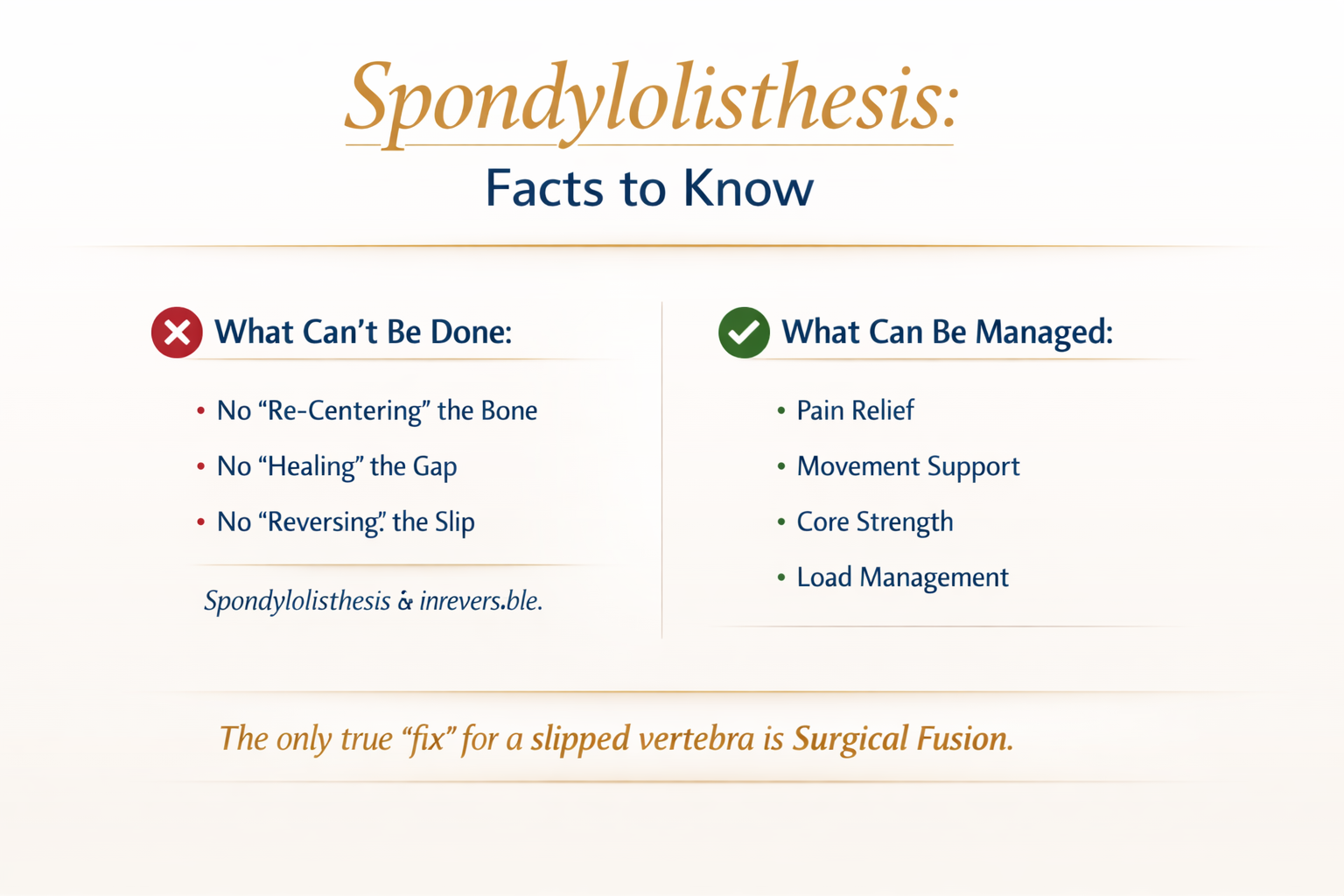
Once a spondylolisthesis develops, it is a structural condition, not a joint that can be “put back into place.”
When the pars interarticularis fails or fractures, the vertebra loses its bony anchor. The body fills the gap with fibrous tissue, creating an irreversible pseudo‑union. No adjustment, mobilisation, or manual therapy can realign or “fix” a slip. Surgery is the only structural fix; non-surgical care focuses on pain management, stability, and safe movement.
How Spondylolisthesis Is Graded
The Meyerding system grades the severity of the slip based on how far the upper vertebra has displaced forward:
| Grade | Displacement Percentage | Classification |
|---|---|---|
| Grade I | 0 – 25% | Low-Grade / Mild |
| Grade II | 26 – 50% | Low-Moderate |
| Grade III | 51 – 75% | Moderate-High |
| Grade IV | 76 – 100% | High-Grade |
| Grade V | > 100% | Spondyloptosis (Complete Displacement) |
Which Grades Can Chiropractors Manage?
Chiropractors do not treat the slip itself. Instead, care focuses on pain management, mobility, muscular control, and functional capacity within safe, evidence-informed boundaries.
Grade I (0–25% Slip)
Primary Conservative CareFocus: Symptom control, movement confidence, and active lumbopelvic stabilization.
- Gentle mobilisation above/below the slip level
- Core and lumbopelvic stabilisation (transverse abdominis, multifidus, glutes)
- Activity modification (reducing early hyper-extension loading)
- Ergonomics and gradual load-management coaching
Grade II (26–50% Slip)
Conservative + MonitoringFocus: Anti-shear stability and functional control.
- All Grade I strategies with structured stabilization
- Strict avoidance of high-velocity manipulation at the slip level
- Active monitoring for radicular (nerve) symptoms
- Co-management with GP if pain is elevated
Grade III (51–75% Slip)
Supportive Care OnlyFocus: Protecting the segment and maintaining functional capacity.
- Mobilisation limited strictly to adjacent segments
- Strong emphasis on core endurance and hip strength
- Avoid extension loading and repetitive shear forces
- Specialist referral if neurological signs or progressive slips occur
Grade IV & V (76% to >100% Slip)
Medical / Surgical LeadFocus: Safety, neurological monitoring, and comfort-based supportive care under medical supervision.
- Mandatory diagnostic imaging and surgical consultation
- No direct manual therapy to the level of the slip
- Supportive mobility away from the affected region
What Causes Spondylolisthesis?
Spondylolisthesis isn’t a single condition—it is a common pathway stemming from several distinct origins:
1. Isthmic (Pars Defect)
A defect or fracture in the pars interarticularis. Common in adolescents participating in repetitive hyper-extension sports like gymnastics, diving, or cricket bowling.
2. Degenerative
Age-related changes in facet joints and discs reducing stability. Most common in adults over 50 (typically L4–L5) and often coexists with spinal stenosis.
3. Traumatic
A high-force impact or injury that fractures posterior spinal elements (excluding the pars), compromising overall stability.
4. Dysplastic (Congenital)
An abnormal development of the facets or posterior arch present from birth that predisposes the spine to slipping during growth.
5. Pathological
Underlying systemic bone diseases, infections, or tumours that weaken the structural integrity of the bone.
6. Postsurgical (Iatrogenic)
Develops following decompressive spinal surgical procedures where stabilising structural elements were removed or altered.
Key Clinical Takeaway
Diagnostic imaging is essential to confirm a slip, identify its grade, and map out a safe treatment plan. Conservative care provides strong value for symptom relief, load management, and core stabilization—especially in stable, low-to-moderate grades.
References and resources
1- Boszczyk BM, Boszczyk AA, Boos W, Korge A, Mayer HM, Putz R, Benjamin M, Milz S. An immunohistochemical study of the tissue bridging adult spondylolytic defects--the presence and significance of fibrocartilaginous entheses. Eur Spine J. 2006 Jun;15(6):965-71. doi: 10.1007/s00586-005-0986-3. Epub 2005 Sep 7. PMID: 16151708; PMCID: PMC3489425.